Music
Music is a powerful, creative and expressive subject that enables children to engage intellectually, emotionally, physically and kinaesthetically. Through music, pupils develop confidence, resilience, creativity and a sense of achievement. Music performance and composition are collaborative, interpersonal activities in which social skills are nurtured through the sharing of ideas, skills and instruments.
Aims and Intent
Statement of Intent
At Rosehill Junior School, we intend to deliver a high-quality, ambitious, and inclusive music curriculum that inspires curiosity, creativity, and confidence. Music learning is cumulative and spiral in nature, meaning that pupils revisit concepts in increasingly complex contexts, reinforcing knowledge and skills over time.
Our intent is that, by the end of Key Stage 2, pupils will:
-
Be confident performers, composers, and listeners, able to express themselves musically both within and beyond school.
-
Show respect for and understanding of a wide range of musical styles, cultures, and historical contexts.
-
Understand how music can be written down and used to support performance and composition.
-
Demonstrate enthusiasm for music and develop their own musical tastes.
-
Meet the end-of-key-stage attainment targets set out in the National Curriculum for Music.
Inclusion is central to our intent. We aim to remove barriers to learning and ensure that all pupils, including those with SEND, can access and succeed in music.
Statement of Implementation
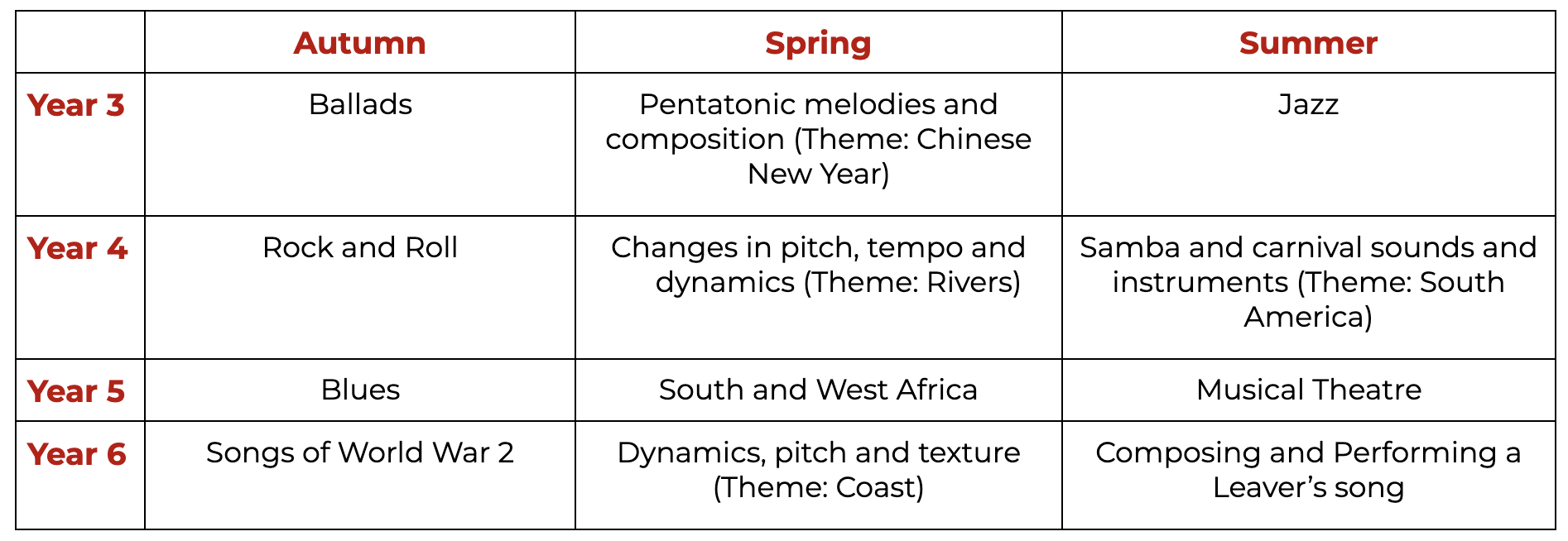
Music is taught in half-termly units, following the Kapow Primary Music Scheme progression from Year 3 to Year 6. Each unit builds on prior learning to ensure the sequential development of musical knowledge, skills, and vocabulary.
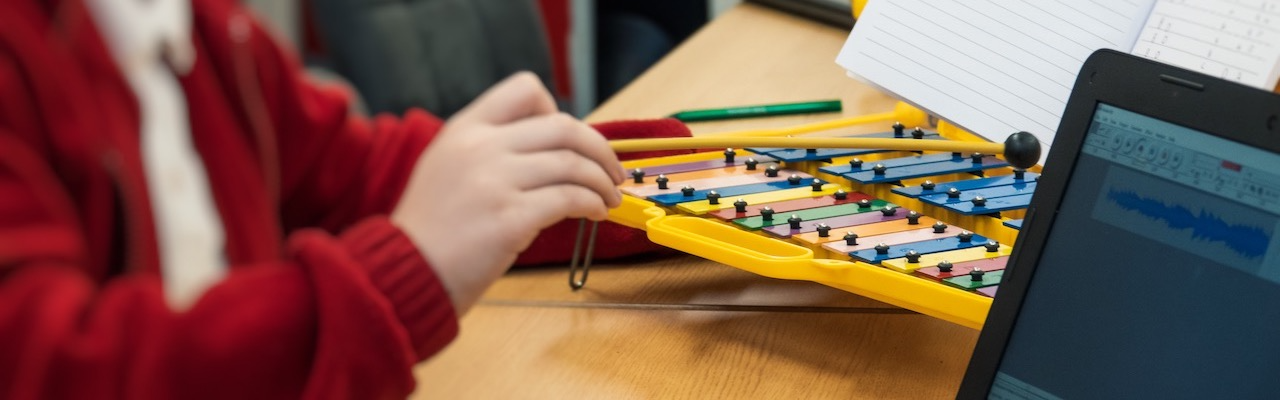
Lessons are practical, engaging, and inclusive, allowing pupils to:
-
Listen to and evaluate a range of music from different cultures, genres, and historical periods.
-
Develop vocal skills through regular singing.
-
Learn to play tuned and untuned instruments.
-
Understand and use musical notation.
-
Improvise and compose using structured frameworks.
-
Perform confidently to an audience.
Teaching incorporates a variety of strategies, including whole-class instruction, paired and group work, improvisation, and teacher-led demonstrations. Cross-curricular links are made where appropriate, integrating music with English, History, Geography, and Performing Arts.
Lessons include differentiated activities and scaffolding to ensure all pupils can access the curriculum. Knowledge organisers, visual prompts, and practical demonstrations support understanding, retention, and progression. Teachers are supported through video guidance, CPD webinars, and resources provided by Kapow to ensure high-quality delivery regardless of prior subject expertise.
Singing Assembly
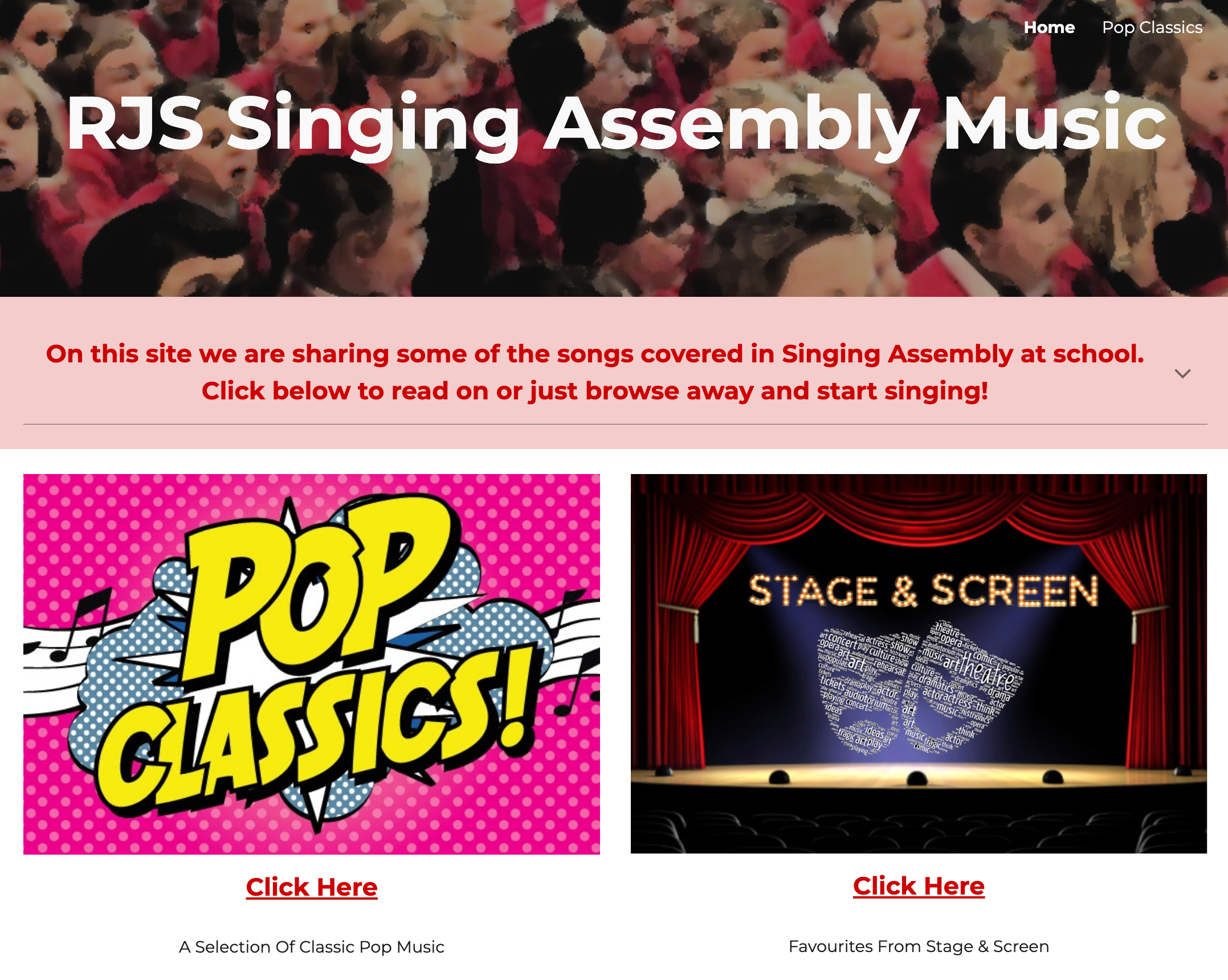
In our singing assemblies we try to share the love of singing together. We choose a range of modern and classic songs and also take requests from the children. By clicking on the link below, you will be able to see some of the content we use on our purpose-built website. You can practice and sing along at home to help raise your confidence and learn some of the more difficult parts within the songs. Click Here or on the image below to visit our Singing Assembly Website.